


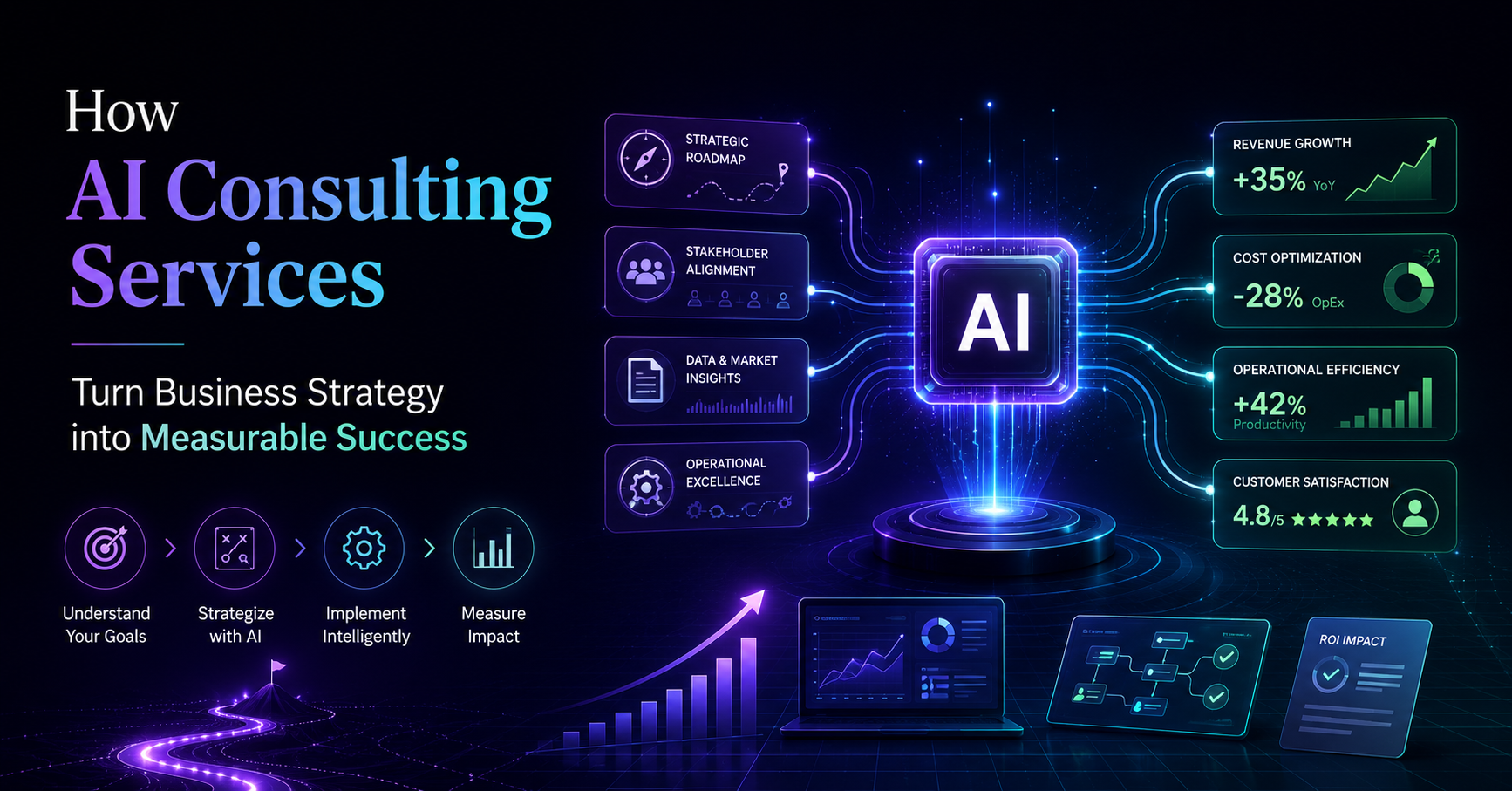
Artificial intelligence is changing how companies make decisions, serve customers, manage operations, and compete. Yet adopting AI does not automatically create business value. Many organisations invest in tools or pilot projects without clearly defining the problem they need to solve. The result is often a disconnected solution that employees do not use and leaders cannot measure.
AI consulting services help prevent that outcome. Consultants connect business priorities with data, technology, workflows, people, and measurable performance indicators. Through AI strategy and roadmap consulting, a company can identify valuable use cases, set realistic priorities, reduce implementation risks, and create a practical path from planning to deployment.
The objective is not simply to use AI. It is to apply AI where it can lower costs, increase revenue, improve accuracy, strengthen customer experiences, or support faster decisions.
What Are AI Consulting Services?
AI consulting services help organisations plan, build, implement, and improve artificial intelligence solutions. Consultants evaluate the company’s strategy, current processes, data readiness, technical infrastructure, security requirements, employee capabilities, and expected return on investment.
Common services include:
- AI strategy development
- Business process assessment
- AI use case identification
- Data readiness analysis
- Machine learning and generative AI planning
- AI agent and automation design
- Technology and vendor selection
- System integration
- AI governance and risk management
- Employee training and change management
- Model monitoring and optimization
A strong engagement begins with a business problem, not a technology trend. Consultants first determine what needs to improve and then decide whether AI is the most suitable solution.
Why AI Projects Often Fail to Deliver Business Value
AI initiatives commonly struggle when leadership and technical teams define success differently. Executives may want lower costs, faster service, stronger customer retention, or increased revenue. Technical teams may focus on model accuracy, architecture, or processing speed.
Those technical measures matter, but they do not prove that the project is helping the business.
For example, a customer churn model may accurately identify customers likely to leave. However, it creates little value unless employees can use the prediction to contact those customers, offer relevant support, and improve retention.
AI consultants close this gap by defining how the solution will be used, who will use it, what workflow will change, and which business metrics will demonstrate success.
How AI Consulting Converts Strategy into Results
1. Turning Broad Goals into Measurable Objectives
Companies often begin with broad goals such as “improve customer service” or “automate operations.” Consultants translate these ideas into specific problems and measurable targets.
For customer service, measurable objectives could include:
- Reduce average response time
- Automate repetitive questions
- Improve first-contact resolution
- Increase customer satisfaction
- Lower the cost per support request
Clear objectives keep the project focused and help stakeholders evaluate results.
2. Identifying High-Value AI Use Cases
Not every process needs AI. Sometimes traditional automation, better reporting, or workflow redesign is more practical.
AI consultants compare potential use cases based on business impact, data availability, cost, risk, implementation difficulty, and time to value. Common opportunities include:
- Predicting customer demand
- Automating document review
- Personalizing marketing campaigns
- Detecting fraud or unusual activity
- Forecasting equipment maintenance
- Summarizing large volumes of content
- Extracting information from forms and contracts
- Scoring sales leads
- Supporting proposal and RFP development
- Recommending next-best actions
The best starting use cases are focused, measurable, and connected to an existing business process.
3. Evaluating Data Readiness
AI systems depend on reliable and relevant data. Many organizations have information spread across spreadsheets, customer systems, documents, emails, legacy applications, and cloud platforms. That data may be incomplete, duplicated, outdated, poorly organized, or difficult to access.
Consultants assess data quality, volume, ownership, security, privacy, historical coverage, bias, and integration requirements. This analysis shows whether the company is ready to proceed or must first strengthen its data foundation.
Finding data problems during planning is less expensive than discovering them after development begins.
4. Creating a Practical AI Roadmap
An AI roadmap turns priorities into an organized implementation plan. It identifies what should happen first, which resources are required, how systems will connect, and how outcomes will be measured.
A typical roadmap may cover:
- Business and process assessment
- Data preparation
- Pilot selection
- Prototype development
- User testing
- Production deployment
- Employee training
- Performance monitoring
- Expansion into additional use cases
The roadmap should also define responsibilities, budgets, timelines, dependencies, governance requirements, and expected benefits. This prevents the business from launching disconnected AI projects without a long-term direction.
5. Choosing the Right AI Technology
Consultants help determine whether the company should build a custom solution, purchase an existing platform, or combine both approaches. They compare scalability, security, integration, ownership cost, implementation effort, vendor dependency, and future flexibility.
The most advanced technology is not always the best option. The right tool is the one that meets the business need without creating unnecessary cost or complexity.
6. Testing Before Full Deployment
A pilot tests assumptions before a major investment. It shows whether the data is sufficient, the system is usable, and the expected benefits are realistic.
Testing should cover accuracy, speed, security, integration, operational impact, and user adoption. The key question is whether the solution delivers enough value to deploy and scale.
A successful pilot also provides evidence that leadership can use when deciding whether to continue investing in the initiative.
7. Integrating AI into Daily Workflows
An AI model creates limited value if it remains separate from the systems employees use. Consultants integrate AI with CRM, ERP, procurement, customer support, marketing, document management, analytics, and other business platforms.
They also define how employees should use the output.
For example, an AI forecasting tool may send demand predictions directly to inventory planners. A contract analysis tool may flag missing clauses inside the procurement workflow. A sales model may recommend follow-up actions within the CRM.
This integration turns an isolated technical capability into a repeatable operational improvement.
8. Supporting Employee Adoption
Employees may resist AI when its purpose is unclear or training is weak. Consultants support adoption through leadership communication, role-based training, human review procedures, feedback channels, and clear accountability.
Employees should understand what the system does, when human judgment is required, and how errors should be reported.
Successful AI adoption does not depend only on technology. It also depends on whether people trust the system and understand how it supports their work.
How to Measure AI Consulting Success
AI success should be measured across four areas:
- Business performance: Revenue, costs, retention, conversion rates, risk reduction, and speed to market.
- Operational improvement: Time saved, fewer errors, shorter response times, reduced manual work, and increased output.
- Technical performance: Accuracy, error rates, response speed, uptime, and integration quality.
- User adoption: Active users, usage frequency, satisfaction, completed training, and accepted recommendations.
A technically accurate model is not successful if employees avoid it or if it fails to improve business outcomes.
Before implementation begins, organizations should record baseline performance. This makes it easier to compare results after the AI solution is deployed.
For example, if the objective is to accelerate document review, the company should measure the current review time, error rate, staffing effort, and completion volume. The same metrics can then be tracked after deployment.
Examples of Measurable AI Outcomes
Customer Service
AI assistants can answer common questions, summarize conversations, and suggest responses to support agents.
Measurable outcomes may include lower response times, fewer escalations, higher first-contact resolution, and reduced support costs.
Manufacturing
Predictive maintenance systems can identify equipment at risk of failure before a breakdown occurs.
Results may include less equipment downtime, fewer production interruptions, lower maintenance costs, and improved equipment availability.
Procurement
AI can extract requirements, review supplier proposals, compare responses, and identify scoring inconsistencies.
The organization can measure faster proposal evaluations, reduced manual review, improved scoring consistency, and stronger auditability.
Sales and Marketing
AI can score leads, personalize campaigns, predict customer needs, and recommend follow-up actions.
Useful metrics include conversion rates, customer acquisition costs, sales cycle length, campaign engagement, and revenue per lead.
Common Mistakes Businesses Should Avoid
The first mistake is choosing a tool before defining the problem. AI should support a clear objective rather than become the objective itself.
The second mistake is underestimating data quality. Incomplete or inaccurate data can lead to weak predictions and unreliable recommendations.
The third mistake is treating a pilot as a finished product. Production deployment requires integration, monitoring, security, technical support, and governance.
The fourth mistake is ignoring employee adoption. Users must understand and trust the system before it can produce consistent value.
Finally, organizations should not measure success only through model performance. The most important question is whether AI improves the business.
Choosing the Right AI Consulting Partner
A reliable partner should combine business, technical, operational, and governance expertise.
Look for a company that can:
- Connect AI initiatives to measurable goals
- Assess data readiness honestly
- Build secure and scalable solutions
- Integrate AI with existing systems
- Establish governance and monitoring
- Train employees and support adoption
- Define realistic ROI expectations
- Provide long-term optimization support
The right partner will not claim that AI can solve every problem. It will explain where AI is useful, where another approach may work better, and how to implement the chosen solution responsibly.
A qualified consulting partner should also be willing to challenge unrealistic assumptions. Honest guidance at the planning stage can prevent costly development mistakes later.
Key Takeaways
- AI consulting services turn business goals into structured initiatives by identifying valuable use cases, evaluating data, selecting technology, guiding implementation, and defining success metrics.
- The strongest projects begin with a clear business problem and measurable objectives. They also include employees, security, governance, and workflow integration from the beginning.
- Organisations should measure AI through business impact, operational improvement, technical performance, and user adoption.
- Starting with a focused pilot enables companies to validate value, learn from real users, and gradually expand successful solutions.
Conclusion
AI can improve business performance only when it is connected to a clear strategy, reliable data, practical workflows, and measurable goals. AI consulting services provide the structure needed to move from ideas to implementation while reducing technical, financial, and operational risk.
A capable consulting partner helps leaders prioritize opportunities, select suitable technology, prepare employees, integrate solutions, and monitor results. This is how AI consulting transforms business strategy into outcomes such as lower costs, faster decisions, stronger customer experiences, and sustainable growth.
Organisations that approach AI with clear priorities and realistic expectations are more likely to create long-term value than those that adopt technology without a defined purpose.
Frequently Asked Questions
1. What do AI consulting services include?
AI consulting may include strategy development, use case selection, data assessment, technology selection, AI development, system integration, governance, employee training, and performance monitoring.
2. How can AI consulting improve business performance?
Consultants identify where AI can save time, reduce costs, increase revenue, improve decisions, or strengthen customer service. They also define measurable KPIs so leaders can verify whether the project is delivering results.
3. How long does an AI consulting project take?
A focused assessment or roadmap may take several weeks, while a custom implementation may take several months. Timing depends on data readiness, project complexity, integration, testing, security, and employee training.
4. Is AI consulting useful for small businesses?
Yes. Consultants can help small and mid-sized companies identify affordable, high-impact uses without building a large internal AI team. Examples include document processing, customer support automation, lead scoring, forecasting, and workflow automation.
5. How is ROI calculated for an AI project?
AI ROI compares total project costs with measurable benefits such as labor savings, increased revenue, fewer errors, faster processing, reduced risk, or lower equipment downtime.
6. What data is needed for an AI solution?
Predictive models usually need reliable historical data, while generative AI systems may use documents, policies, product information, or knowledge bases. Data must be accurate, accessible, secure, and appropriate for its intended purpose.
7. What is the difference between AI consulting and AI development?
AI consulting focuses on strategy, readiness, governance, planning, and business alignment. AI development focuses on building, testing, integrating, and deploying the technical solution.
8. How can a company reduce AI implementation risk?
Start with a clear business problem, assess data quality, run a focused pilot, protect sensitive information, establish human review, define governance policies, monitor performance, and train employees before wider deployment.
“`
The HTML uses only inline styling and retains each requested anchor text exactly once.