A business owner doesn’t need money, a big team, or even years of experience in 2026. It’s about how well they use AI.
Email doesn’t start the workday anymore. You start by asking AI a question.
AI tools are now a big part of how businesses work every day. They help with everything from writing proposals and looking at spreadsheets to making marketing plans, guessing how many sales you’ll make, and answering customer questions.
Things that used to take whole teams and hours of work now happen in minutes.
AI isn’t just a test or something that big tech companies do anymore. Today, more than 7 out of 10 business leaders actively use AI tools to make decisions faster, save money, and grow without hiring more people. The change has already taken place, and companies that don’t keep up are quickly falling behind.
But here’s the truth: AI is easy to use; the right AI tools are not.
Business owners often have a hard time answering a simple but important question: “Which AI tools really help businesses and which ones just make noise?” There are hundreds of platforms that promise to automate, make things smarter, and help businesses grow.
No single AI tool will be able to run a successful business in 2026. They use a “smart AI stack,” which is a group of tools that work together to help with strategy, productivity, research, marketing, and getting more customers.
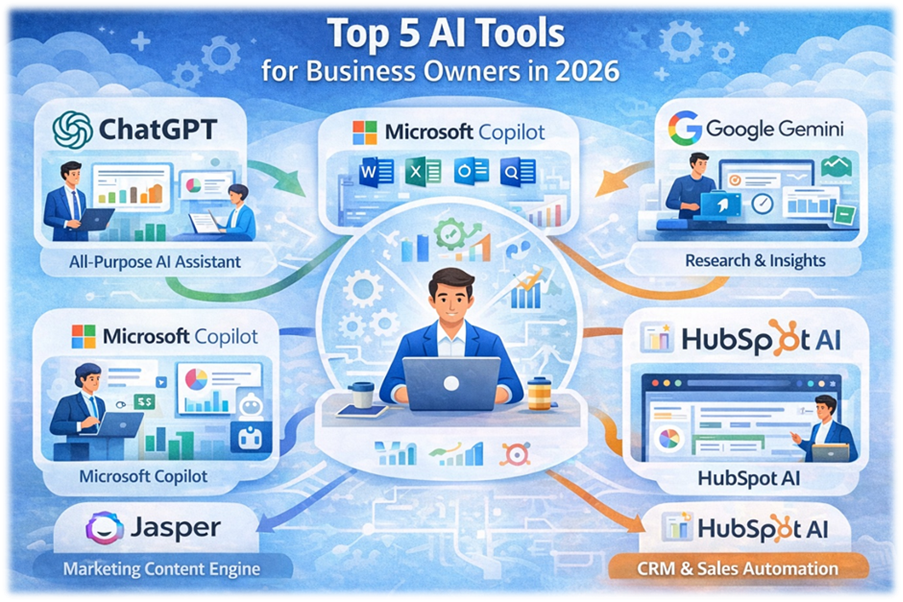
This article lists the five best AI tools that business owners will use in 2026 based on how they are used in the real world, how widely they are adopted, and how much value they bring to businesses. You’ll learn how each tool fits into modern work processes, why so many people use them, and how they help business owners work smarter, move faster, and compete on a large scale.
ChatGPT from OpenAI
OpenAI created ChatGPT, a generative AI platform that helps business owners think, write, analyze, automate, and make decisions more quickly. ChatGPT has grown from a simple chatbot to a multi-functional business AI assistant that is used in almost every field by 2026.
It can talk to people in natural language, look at documents, write code, understand data, understand images, and automate workflows. This is what makes it one of the best AI tools for businesses.
1. Help with making decisions and planning for the business
- Check out what’s going on in the market
- Look at the competition
- Look at how you set prices
- Make plans for your business and pitch decks. Write short reports for investors or the board of directors.
ChatGPT is like a “virtual strategy consultant,” which is great for small and medium-sized businesses that don’t have big teams of analysts.
2. Creating and promoting content
- Blog posts and SEO content
- Captions for social media (LinkedIn, X, Instagram)
- Email campaigns and newsletters
- Copy for websites and landing pages
- Ad creatives and A/B test versions
ChatGPT is better than regular tools because it can change the tone, context of the industry, and the intent of the audience. This is great for “on-brand marketing at scale.”
3. Writing Proposals and Sales Letters
- Write proposals and answers to requests for proposals (RFPs)
- Write emails and sales scripts to get in touch with people Make each pitch different for each ICP. Make a summary of notes and transcripts from CRM calls. This speeds up the process of getting proposals back and makes the responses better.
4. Help for customers and internal operations
- Answer questions from customers about support
- Create knowledge bases for help desks and FAQs Show your internal teams how to use SOPs Write down the meetings and tasks that need to be done.
Many businesses use ChatGPT in their support workflows to cut down on the number of tickets and the time it takes to respond.
How Many People Used ChatGPT in 2026
Note: The percentages below come from several industry reports and surveys of how many people are using AI.
Around 75–80% of companies that use AI say they use ChatGPT for at least one thing.
About 70% of people who use AI at work say ChatGPT is the AI tool they use the most.
About 60% of small and medium-sized businesses use ChatGPT to talk to customers, make content, or market their products.
About 45–50% of big companies use ChatGPT along with other tools like Copilot or their own LLMs. There are over 800 million people who use it every week, both consumers and professionals.
This means that ChatGPT will be the most used AI tool by businesses in 2026.
Why ChatGPT is the Most Popular AI in 2026
Works in any area, Simple to learn, Works with a lot of business functions and always gets new ones. Many plugins, APIs, and integrations work well with each other.
Best Fit Business Types
- Startups and the people who start them
- Small and medium-sized businesses
- Marketing agencies
- Consulting firms
- Procurement and proposal teams
- SaaS companies
- Businesses that provide services
2: Microsoft Copilot
What is Microsoft Copilot?
Microsoft Copilot is an AI assistant that comes with Microsoft 365, which includes Word, Excel, PowerPoint, Outlook, Teams, and SharePoint. Copilot is the “default AI layer for business productivity” in 2026, especially for companies that already use Microsoft tools.
Copilot can’t be used as a separate chatbot. Instead, it works with the apps that business owners already use, making everyday tasks smarter with AI.
1. Writing and creating business papers
Write rules, contracts, proposals, and reports
Make the writing sound more professional or ready for a boss. Make long documents into important points. Turn your notes into well-organized documents.
For most people who use computers, Copilot cuts the time it takes to make documents by 30–50%.
2. Using Excel to Look at Data and Report Financial Information
One of the best things Copilot can do in 2026 is automate Excel:
Make formulas automatically Look at the income, expenses, and predictions. Make charts and dashboards out of raw data. When talking about trends, use plain business language.
This is a big help for teams that deal with money, buy things, and run things.
3. Setting up automatic email and communication (Outlook + Teams)
Write and summarize emails Follow up on meetings and write summaries of them. Make sure that action items from Teams meetings are easy to see. Write down the agenda and a summary after the meeting.
This cuts down on a lot of meetings and emails.
4. Reports and Presentations for Executives
Copilot helps make:
- PowerPoint slides made from Word documents
- Executive summaries for meetings with leaders
- Presentations that are ready for clients and have stories that are easy to understand
This quickly turns “raw ideas into polished deliverables” for managers and business owners.
Microsoft Copilot Usage Statistics in 2026
The percentages below are based on surveys of people who work with Microsoft products and AI to guess how many small and large businesses use these technologies.
About 65–70% of businesses that use Microsoft 365 have either turned on or tried out Copilot.
About 58–62% of people who work with Microsoft use Copilot every week.
About half of medium-sized businesses use Copilot to write reports, keep records, or send automated emails.
About 40–45% of business owners
who use Microsoft 365 think Copilot is their main productivity AI.
Most of the people who use Copilot work in finance, human resources, procurement, operations, or project management.
In 2026, Copilot is the most used AI in business settings.
Why Microsoft Copilot Will Matter to Businesses in 2026
- Comes with built-in tools (no need to learn new ones)
- Security and compliance that businesses can use
- Handles company data like emails, files, and meetings
- Works well for structured workflows with a lot of documents
- Lessens reliance on AI platforms that aren’t part of the company
For many businesses, Copilot is the “AI assistant that employees use without knowing it.”
Best Fit Business Types
- Businesses of all sizes, even small and medium-sized ones
- Government and public sector organizations
- Finance, procurement, and HR teams
- Project managers and operations leaders
- Businesses already use Microsoft 365 as their standard.
3: Google Gemini
What is Google Gemini?
Google Gemini is Google’s multimodal generative AI platform that works great with all of its products, including Google Cloud, Android, Search, Gmail, Docs, Sheets, Slides, and Drive.
By 2026, Gemini will be the “AI brain behind Google Workspace.” Business owners can do research faster, analyze data better, and automate everyday knowledge work without leaving Google tools.
Gemini is different from other AI chat tools because it is part of the workflows that businesses already use.
1. Researching businesses and gathering market information
- Look at what your competitors are doing and what’s happening in the market.
- Look at how customers act and what they want to find. Summarize long reports, PDFs, and web pages
- Look at what people are looking for on Google right now to see if your ideas are good.
- Gemini’s strength is in accuracy of research and grounding in context, especially when making decisions based on a lot of data.
2. Using Google Docs to Make Content
- Writing reports, proposals, and blogs
- Making things clearer, changing the tone, and changing the structure
- Summarizing long documents right away
- Making full stories out of bullet points
This means that teams that already use Google Workspace don’t have to copy and paste their work into other AI tools.
3. Business Analytics and Automating Sheets
Gemini is a well-liked tool in Google Sheets for:
- Use plain language to explain formulas
- Make formulas on their own
- Look at data on sales, finance, and operations to find patterns and things that don’t fit.
Gemini is very helpful for founders, finance teams, and operations managers because of this.
4. Help with email and workflow (Gmail and Drive)
- Write and summarize emails in Gmail
- Quickly reply to and follow up on emails
- Search for and summarize files in Google Drive
- Organize documents and tasks
This greatly reduces the number of emails you get and the time you spend looking for files.
How Many People Used Google Gemini in 2026
The following percentages are based on the use of Google Workspace, AI workplace surveys, and the ecosystem.
55–60% of businesses that use Google Workspace actively use Gemini features
50% of startup founders that use Google tools use Gemini every week
45% of SMBs use Gemini for research, documentation, or analytics
5–40% of enterprises use Gemini with Copilot or ChatGPT
Gemini adoption is highest in startups, marketing teams, analysts, and remote-first companies
Gemini is the second most popular AI for Google-focused businesses in 2026, after ChatGPT.
Works with Google Workspace right away, Great for doing research in real time, Good for looking at data and writing reports, Simple to learn, Good for teams that work from home or are spread out.
Gemini is the default AI layer in Google tools for many businesses, not a separate product.
Best Fit Business Types
The best things to do with Google Gemini are:
- Tech companies and startups
- Marketing and growth teams
- Organizations that do research
- Teams that work from home or in a hybrid setting
- Businesses that use Google Workspace as their main tool
4: Jasper
What is Jasper?
Jasper is a generative AI platform made just for marketing and sales teams. Jasper is not a general-purpose AI tool; it is made to help businesses make a lot of marketing content that is both on-brand and focused on conversions.
By 2026, Jasper has become a dedicated AI marketing engine instead of just a general AI assistant.
1. Long-Form Content and Search Engine Optimization
Jasper is used by business owners and marketing teams to:
- Write blog posts that are good for SEO
- Make landing pages and website copy
- Make pillar pages and content clusters
- Rewrite text to make it easier to read and rank higher
Jasper’s strength is in structured, marketing-ready outputs, which is especially useful for businesses that publish a lot of content.
2. Ads that cost money and copy that converts
Google Ads and Meta ad copy, A/B testing different ads, CTAs that get a lot of clicks, Product descriptions for eCommerce
Marketing teams use Jasper to speed up the launch of campaigns while keeping the message the same.
3. Consistency in Brand Voice and Content
- One thing that sets Jasper apart is Keeps the brand’s tone the same across all teams
- Makes sure that the message is the same across all channels Follows the brand’s style and guidelines
This is very important for teams with more than one writer, agencies, and brands that are growing.
4. Campaigns on social media and Email
- Posts on LinkedIn and X (Twitter)
- Email marketing sequences
- Content for newsletters
- Campaign messages that fit with the brand voice
Business owners often use Jasper with other tools like HubSpot or Mailchimp.
Jasper Usage Statistics for 2026
Because Jasper is a specialized marketing AI, its use is measured by function instead of total population.
38–42% of marketing teams using AI rely on Jasper or similar AI-first marketing tools *
45% of content-driven SMBs use Jasper for blogs, ads, or email marketing
30–35% of agencies list Jasper as a core content production tool
70% of AI-assisted marketing content in SMBs is created using specialized tools like Jasper, not general AI chatbots
Jasper adoption is highest in SaaS, eCommerce, B2B services, and agencies
In 2026, Jasper is the best in the field of AI-powered marketing content.
- Made just for marketing needs
- Strong focus on SEO and conversions
- Control over brand voice at scale
- Faster campaign execution
- Less manual editing needed
For businesses that focus on marketing, Jasper is often better than general AI tools at content quality and consistency.
Best Fit Business Types
- Companies that sell software as a service (SaaS)
- Marketing agencies
- eCommerce brands
- B2B service providers
Businesses that have a lot of content
5: HubSpot AI
What is HubSpot AI?
HubSpot AI is an AI-powered layer that is built into HubSpot’s
CRM, Marketing Hub, Sales Hub, Service Hub, and Operations Hub.
HubSpot AI is no longer just a “marketing add-on” by 2026. It has become a “core growth engine” for business owners who want to “attract, convert, engage, and retain customers using data-driven automation.”
HubSpot AI works directly with real customer data, which makes its results very useful. This is different from other AI tools that don’t do this.
1. Lead generation and scoring powered by AI
HubSpot AI helps business owners with:
- Automatically rate leads based on their actions and goals
- Find prospects with a high conversion rate
- Prioritize sales outreach
- Cut down on manual CRM work
This helps sales teams focus on buyers who are most likely to convert, not just the loudest leads.
2. Marketing Automation and Personalization
HubSpot AI lets you:
Personalized email campaigns, changing website content, AI-generated subject lines and CTAs, Predictions of how well a campaign will do
Personalization is no longer a choice in 2026, and HubSpot AI does it at scale.
3. Helping Sales and Making Predictions
Business owners use HubSpot AI for:
Predictive revenue insights, Deal forecasting and pipeline visibility, Writing and following up on sales emails, Meeting summaries and CRM updates
This makes it easier to win and speeds up the sales process.
4. Keeping and helping customers
- Run chatbots and automated support
- Suggest articles from the knowledge base
- Analyze how customers feel
- Guess when people will leave and when you can sell them more.
- Customer experience becomes proactive instead of reactive.
HubSpot AI Usage Statistics in 2026
The percentages below are rough estimates based on CRM adoption, martech surveys, and reports on AI in business.
78–82% of businesses using HubSpot actively use at least one AI feature
65% of SMBs rely on HubSpot AI for marketing or sales automation
55% of B2B companies use HubSpot AI for lead scoring and CRM insights
60% of revenue teams using HubSpot say AI directly impacts pipeline growth
HubSpot AI adoption is highest among SMBs, startups, and scaling SaaS companies
HubSpot AI is the most popular AI CRM platform for growing businesses in 2026.
Why Business Owners Pick HubSpot AI
- AI uses real customer and sales data
- A single platform for CRM, marketing, sales, and service
- Simple to use and set up
- Grows with your business
- Good return on investment for businesses that want to grow
For a lot of business owners, HubSpot AI is the central nervous system of their business growth.
Best Fit Business Types
HubSpot AI is great for:
- Small and medium-sized businesses (SMBs) and mid-market companies
- Software as a Service (SaaS) and Business to Business (B2B) companies
- Companies that focus on marketing and sales
Agencies that work with multiple clients Companies that wanted steady growth
AI tools are now a normal part of how businesses work, and the ones shown here show how businesses will really work in 2026: quickly, clearly, and with a clear goal.
As AI becomes more common, it’s just as important to stay up to date as it is to be efficient.
Visit https://triforcex.ai/ to learn more about how businesses are using AI in the real world. and look into how AI-powered tools are changing the way businesses work today.