

Ready to Turn AI Potential into Business Value?
Don’t settle for disconnected AI tools. Schedule a discovery call with Tri-ForceX to build secure, scalable, and custom intelligent automation for your workflows.
Intelligent Automation: How AI Consultant Companies Drive Real Business Value
Businesses now use artificial intelligence to reduce repetitive work, improve decisions, respond to customers faster, and make better use of data. However, buying an AI tool is not the same as building dependable automation. Successful adoption requires a clear business case, usable data, secure integration, employee involvement, and ongoing monitoring.
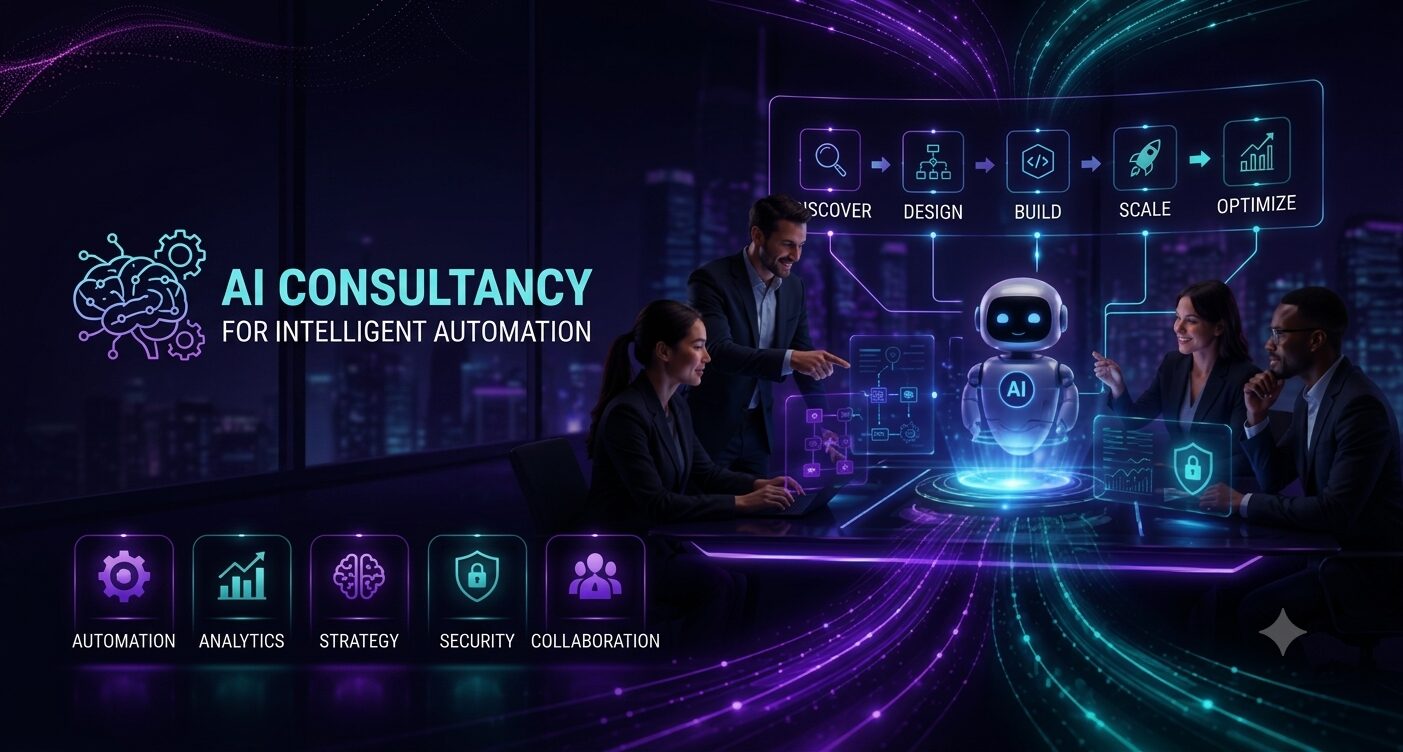
Professional AI consulting services help organisations identify suitable opportunities, select technologies, build custom solutions, and connect AI with existing systems. The goal is not simply to add AI to a process. It is to create intelligent automation that improves how work is completed and delivers measurable business value.
Key Takeaways
AI consultants connect business goals with practical technology, reduce implementation risk, and help companies build automation with measurable outcomes. Strong projects begin with one focused use case and include data, integrations, governance, human oversight, and continuous monitoring.
What Is Intelligent Automation?
Intelligent automation uses AI and automation technologies to complete tasks, interpret information, make recommendations, and support decisions with less manual effort. Traditional automation follows fixed rules. Intelligent automation can also understand language, recognize patterns, process documents, predict outcomes, and respond to changing inputs.
For example, basic automation may move an invoice from an inbox into a folder. An intelligent solution can read the invoice, extract supplier details, compare the amount with a purchase order, flag missing information, route exceptions, and update the accounting system.
Common technologies include machine learning, natural language processing, generative AI, computer vision, robotic process automation, AI agents, APIs, and human approvals. AI supports learning, reasoning, language understanding, problem-solving, and decision support. Intelligent automation applies these capabilities to operational workflows (Google Cloud).
Why Businesses Need AI Consultant Companies
Many organisations want to use AI but do not know where to begin. They may have disconnected systems, inconsistent data, manual processes, strict security requirements, or multiple departments requesting different tools. Starting without a plan can create expensive pilots that never reach production.
AI consultant companies combine business analysis, data engineering, software development, automation, integration, and change-management skills.
They determine which process to automate first, whether the data is suitable, whether to buy or build, how AI will connect with existing systems, where human approval is required, and how success will be measured.
A capable team evaluates the complete operating environment rather than focusing only on a model. Automation results depend on process design, data quality, system integration, user adoption, and governance.
How AI Consultants Build Intelligent Automation Solutions
1. Identify a Valuable Business Problem
Consultants begin by speaking with leaders, process owners, employees, and technical teams. They review delays, repetitive tasks, errors, handoffs, backlogs, customer complaints, and operating costs.
The objective is to find a problem that is valuable, measurable, and realistic. “Use AI in customer service” is too broad. A better use case is “classify incoming requests, suggest relevant answers, and route urgent cases to the correct team.”
A clearly defined problem gives the project a practical scope and makes it easier to measure whether the automation creates value.
2. Map and Improve the Workflow
Before automating, consultants document every action, system, decision, approval, exception, and data source in the current process.
This often reveals duplicate approvals, unnecessary data entry, unclear ownership, or inconsistent rules. Fixing those problems first prevents the organization from automating an inefficient workflow.
The team then creates a future-state process showing what AI will do, what standard automation will do, and where employees will review results. This process also helps employees understand how their responsibilities may change after implementation.
3. Assess Data Readiness
AI depends on relevant, accurate, accessible, and properly governed data. Consultants review data quality, duplicate records, missing fields, storage locations, access permissions, historical volume, sensitive information, and retention rules.
When data is weak, they may recommend cleaning records, standardising fields, creating a data pipeline, improving document labels, or adding human review during the early stages.
A data-readiness assessment also helps determine whether the organization has enough historical information to train, test, or evaluate an AI solution.
4. Select the Right Technology
Not every workflow requires a large language model or custom machine-learning system. Sometimes a rules engine, search tool, existing platform feature, or robotic process automation is sufficient.
Consultants compare options based on cost, complexity, accuracy, security, scalability, integration needs, and support. The final design may combine several technologies.
They also define the solution architecture: how information enters, where it is processed, how users interact with the system, how results are stored, and how failures or exceptions are handled. Selecting technology according to the business problem helps organizations avoid paying for capabilities they do not need.
Confused About Which AI Stack Best Fits Your Enterprise?
Avoid costly trial-and-error. Partner with Tri-ForceX to architect, pilot, and deploy custom automation solutions tailored directly to your legacy platforms and modern software.
5. Build and Test a Focused Pilot
Consultants often start with a proof of concept or limited pilot. This allows the company to test the idea with representative data before making a larger investment.
The team develops the automation logic, interfaces, integrations, approvals, and dashboards. Testing should cover accuracy, speed, security, usability, failure handling, business results, and difficult real-world cases.
The pilot should also have clear success criteria. These may include reducing processing time, increasing first-pass accuracy, lowering manual effort, improving response speed, or reducing the number of unresolved cases. When a pilot performs well, the organisation can gradually increase transaction volume, add users, or expand the automation to related processes.
6. Integrate AI with Existing Systems
Most businesses do not need to replace their entire technology environment. Intelligent automation can connect with CRM, ERP, accounting, HR, procurement, support, document-management, and collaboration platforms.
For example, an AI sales assistant may summarise a call, update CRM fields, and create a custom follow-up task. Tri-ForceX describes this as a full-lifecycle approach covering strategy, implementation, integration, and optimisation.
Integration is important because employees should not need to copy information between multiple applications. The automation should work within established workflows whenever possible.
7. Establish Governance and Human Oversight
AI automation needs controls. Consultants define acceptable use, approvals, data restrictions, audit logs, accountability, and escalation procedures.
Human review is especially important when a system influences financial, employment, healthcare, legal, eligibility, or public-service decisions. In these cases, AI may recommend an action while an authorized employee makes the final decision.
Governance also includes access reviews, privacy protection, vendor risk, model monitoring, documentation, and procedures for correcting inaccurate results. Clear governance makes it easier to investigate errors, explain decisions, manage risk, and maintain stakeholder trust.
8. Support Adoption and Improvement
A strong solution can still fail when employees do not trust it. Consultants support adoption through training, documentation, feedback, and clear responsibilities.
Employees should understand what the automation does, what information it uses, when they should accept its output, and when they should escalate a result for review.
After launch, consultants monitor accuracy, response time, exception rates, adoption, cost, and business outcomes. They then improve prompts, models, integrations, workflows, and training. Intelligent automation is not a one-time installation. It is an operating capability that must evolve as data, regulations, customer expectations, and internal processes change.
Intelligent Automation Examples
| Business Function | Intelligent Automation Example | Potential Business Value |
|---|---|---|
| Customer service | Classify requests, suggest answers, and route complex cases | Faster and more consistent support |
| Finance | Extract invoice data, match records, and flag anomalies | Less manual work and fewer errors |
| Sales | Enrich leads, summarize meetings, and recommend follow-ups | Better lead prioritization |
| Human resources | Answer policy questions and automate onboarding tasks | Lower administrative workload |
| Procurement | Compare responses, flag compliance gaps, and track approvals | Faster supplier reviews |
| Manufacturing | Predict equipment issues and recommend maintenance | Reduced downtime |
These solutions do not eliminate every human task. They handle repetitive and data-heavy work so employees can focus on judgment, relationships, exceptions, and problem-solving.
AI Consultant Company vs. AI Tool Vendor
An AI tool vendor mainly sells a product. An AI consultant company determines how technology should be used within a specific business environment.
A consultant may recommend an existing tool, configure a platform, build a custom solution, or combine systems. This matters when a project involves custom workflows, sensitive data, legacy applications, or long-term scaling.
Tools provide capabilities. Consultants turn those capabilities into an operating solution that works with the organisation’s people, processes, data, and technology environment.
AI consultants can also provide independent advice. Instead of forcing every business problem into one platform, they can recommend the most appropriate mix of custom development, existing products, integrations, and process improvements.
How to Choose an AI Consulting Partner
Choose a company that can explain business outcomes as clearly as technical architecture. A reliable partner should ask detailed questions about users, workflows, data, systems, risks, and success measures before recommending technology.
Evaluate potential providers based on:
- Relevant industry and workflow experience
- AI, software, cloud, data, and integration capabilities
- Security and privacy practices
- A structured discovery and pilot methodology
- Clear project communication and ownership
- Testing and quality-assurance procedures
- Documentation and employee training
- Post-launch monitoring and support
- Ability to work with legacy and modern systems
- Methods for measuring financial and operational results
Be cautious when a provider promises immediate transformation without reviewing your data or processes. Reliable AI implementation requires evidence, testing, collaboration, and realistic assumptions.
A trustworthy consulting partner should also explain technical limitations, implementation risks, ongoing operating costs, and situations in which AI may not be the best solution.
Common AI Automation Mistakes to Avoid
A common mistake is starting with technology instead of a defined problem. Other failures include automating a broken workflow, using poor-quality data, ignoring employees, selecting too many use cases, and launching without measurable goals.
Businesses may also underestimate integration, maintenance, cloud usage, data preparation, training, and governance costs. These expenses should be included in the project plan from the beginning.
Companies should avoid removing human review too early. A phased approach gives teams time to test accuracy, understand exceptions, and build trust.
The best first project is usually not the most impressive idea. It is the one that can produce meaningful evidence with manageable risk.
Measure Business Value Before Scaling
Before expanding an automation solution, compare its results with a documented baseline. Useful measures include processing time, cost per transaction, employee capacity, error rate, rework, customer satisfaction, response speed, adoption, and revenue impact.
A structured approach to the ROI of AI automation should include implementation expenses, recurring operating costs, integrations, internal labor, monitoring, and human exception handling.
It should also separate verified financial gains from benefits that are useful but harder to monetize. These softer benefits may include faster access to information, improved employee experience, better decision quality, stronger compliance visibility, and more consistent customer service. Tri-ForceX recommends reviewing these measures regularly instead of evaluating the project only at launch. Ongoing measurement shows whether the automation should be improved, expanded, redesigned, or retired.
Conclusion
AI consultant companies help businesses move from general interest in AI to practical, secure, and measurable automation. They find valuable use cases, improve workflows, prepare data, choose technology, build integrations, establish governance, and support employee adoption.
The best intelligent automation solutions are not built around trends. They are built around a clear problem, reliable information, responsible controls, and measurable outcomes.
Starting with one focused workflow allows a business to reduce risk, prove value, and create a foundation for wider AI transformation. With the right consulting support, intelligent automation can become a dependable business capability rather than another disconnected technology experiment.
Frequently Asked Questions
1. What does an AI consultant company do?
An AI consultant company helps businesses plan, build, integrate, and improve AI solutions. Services may include use-case discovery, data assessment, process mapping, technology selection, custom development, governance, training, and performance monitoring.
2. What is the difference between automation and intelligent automation?
Traditional automation follows predefined rules. Intelligent automation adds capabilities such as language understanding, prediction, document interpretation, and decision support, allowing it to handle more complex information.
3. Can small businesses use intelligent automation?
Yes. Small businesses can begin with focused uses such as lead follow-up, invoice processing, customer-service routing, appointment scheduling, document summarization, or reporting. The use case should be selected according to business value, available data, budget, and risk.
4. How long does an AI automation project take?
Timing depends on process complexity, data readiness, integrations, security reviews, testing, and training. A focused pilot may take weeks, while a multi-system implementation may take several months.
5. Can AI connect with existing CRM and ERP systems?
Yes, when the systems provide suitable APIs, connectors, database access, or controlled automation options. Consultants design secure data flows so AI can work with existing applications without requiring the company to replace its complete technology environment.
6. How much does intelligent automation cost?
Cost varies by use case, integrations, data preparation, customization, security, and support. Companies should evaluate total cost of ownership, not only the initial development or licensing fee.
7. Is intelligent automation secure?
It can be secure when designed with access controls, encryption, approved data use, logs, testing, monitoring, vendor review, and incident procedures. Security and privacy requirements should be included from the beginning of the project.